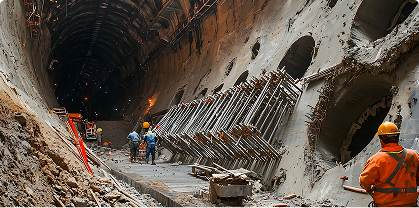
Modern tunnels are critical components of urban infrastructure, supporting transportation, water conveyance, utilities, and transit systems. Ensuring their structural integrity during and after construction is essential for safety, performance, and long-term durability. Geotechnical instrumentation plays a central role in monitoring tunnel behavior, providing engineers with real-time data to verify design assumptions, detect potential issues early, and guide construction decisions.
Why Tunnel Monitoring Is Necessary
Tunnel construction alters the natural stress conditions in the surrounding ground. Excavation can cause soil and rock to deform, leading to settlement at the surface, movement of nearby structures, or stress concentrations around the tunnel lining. Without proper monitoring, these changes can go undetected until they become serious problems.
Geotechnical instrumentation allows engineers to measure these changes as they occur, helping to confirm that the tunnel and surrounding ground are behaving as expected. If unexpected movement or stress is detected, corrective measures can be implemented before safety or performance is compromised.
Key Types of Instrumentation Used in Tunnel Monitoring
A variety of instruments are used to monitor tunnel integrity, each designed to measure specific parameters:
Inclinometers and Shape Arrays
These instruments measure lateral ground movement and deformation. Installed in boreholes near or above tunnels, they help engineers track how soil or rock shifts during excavation and operation.
Settlement Points and Surface Monitoring Points
Installed on the ground surface or nearby structures, these points measure vertical movement over time. This is especially important in urban areas where tunnels pass beneath roads, buildings, or utilities.
Extensometers
Extensometers measure internal ground movement at various depths. They provide insight into how the soil or rock mass deforms above and around the tunnel.
Strain Gauges and Load Cells
These instruments are installed within tunnel linings or support elements to measure stress and load distribution. They help confirm that structural components are performing as designed.
Piezometers
Piezometers measure groundwater pressure, which can significantly affect tunnel stability. Monitoring pore water pressure helps engineers assess seepage conditions and potential uplift forces.
Monitoring During Construction and Operation
Instrumentation is typically installed before tunnel excavation begins to establish baseline readings. As excavation progresses, readings are collected regularly—sometimes in real time—to track changes. This allows engineers to compare measured values against predicted performance.
Monitoring often continues after construction is complete, particularly for critical infrastructure projects such as transit tunnels or water conveyance systems. Long-term monitoring helps verify that the tunnel remains stable and performs as intended.
Benefits of Instrumentation-Based Monitoring
Geotechnical instrumentation provides several key benefits:
- Early detection of potential issues, such as excessive settlement or lining stress
- Verification of design assumptions, improving confidence in engineering models
- Enhanced safety for workers, nearby structures, and the public
- Optimized construction methods, allowing adjustments based on real-world data
- Long-term performance monitoring, ensuring infrastructure reliability
Supporting Safe and Reliable Tunnel Infrastructure
Geotechnical instrumentation transforms tunnel monitoring from a reactive process into a proactive one. By providing accurate, continuous data on ground and structural behavior, engineers can make informed decisions throughout the tunnel’s lifecycle.
As tunnel construction continues to expand in urban and infrastructure projects, instrumentation will remain an essential tool for ensuring safety, quality, and long-term performance.